What Is Prasna Kundli and How Does Horary Astrology Work Without Birth Details?
Quick Answer: A Prasna Kundli (प्रश्न कुंडली) is a horary chart cast for the exact moment and place a question is asked — not for a person’s birth. Rooted in the ancient text Prasna Marga (composed in 1649 CE in Kerala), Vedic horary astrology holds that the cosmic snapshot at the instant of inquiry carries the answer. You don’t need a birth date, time, or place. You only need a sincere question, asked at a specific moment.
🔮 FREE AI Astrology Reading
Get your personalized Kundli, Rashifal & planetary insights — powered by Vedic astrology
100% FREE • No credit card required
If you’ve ever wanted to consult an astrologer but didn’t know your exact birth time, Prasna Kundli is the answer. It’s one of the six branches (angas) of Jyotish Shastra, and it has been used for centuries across South India — especially in Kerala, where the Prasna Marga tradition remains a living practice to this day.
Here’s what you need to know about how it works, when to use it, and what the ancient texts actually say.
What Exactly Is a Prasna Kundli?
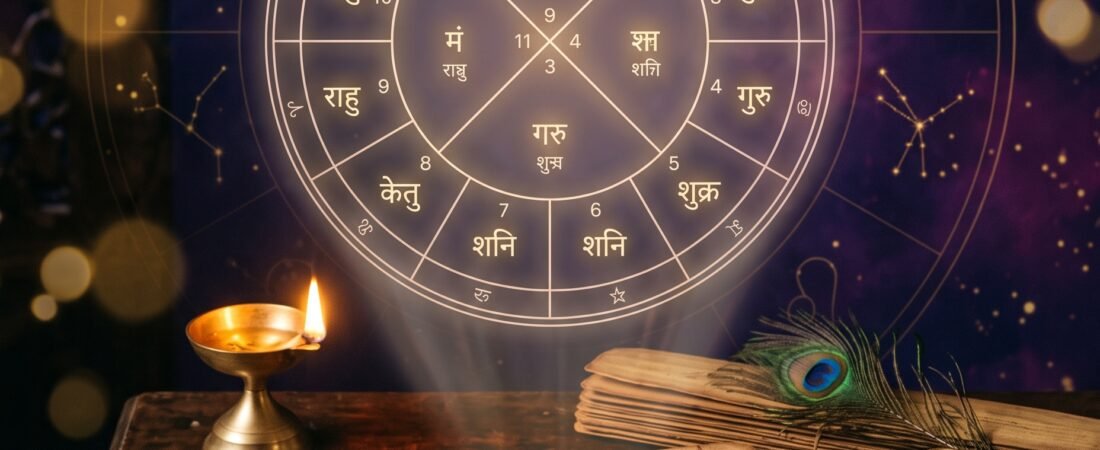
The word Prasna (प्रश्न) means “question” in Sanskrit. A Prasna Kundli is simply a birth chart — with a Lagna (ascendant), twelve houses, planetary placements, and aspects — but instead of being calculated for someone’s birth, it is calculated for the moment a question is posed to an astrologer.
The underlying principle is elegantly simple: if the universe is interconnected, then the moment a genuine question arises in a seeker’s mind is not random. The planetary configuration at that instant reflects the nature of the question and its answer.
As the Prasna Marga (Chapter 1, Verse 3) states:
“When a questioner approaches with a sincere heart, the heavens themselves frame the answer. The moment of questioning is the moment of revelation.”
This is not a modern invention. The tradition traces back to at least the 7th century CE in Sanskrit astrological literature, with significant contributions from scholars like Varahamihira (who discussed horary principles in the Brihat Jataka) and later Sankara Varman, the primary author of the Prasna Marga in 17th-century Kerala.
How Does Prasna Kundli Work Without Birth Details?
In a standard Janam Kundli, the chart is built from three inputs: date of birth, exact time of birth, and place of birth. Without all three — especially the time — the Lagna cannot be determined, and predictions become unreliable.
Prasna Kundli replaces all three birth inputs with two new ones:
| Parameter | Janam Kundli | Prasna Kundli |
|---|---|---|
| Input required | Birth date, time, place | Question moment + place |
| Lagna calculation | From birth time | From the moment the question is asked |
| Primary house for the question | Depends on topic (7th for marriage, 10th for career) | Same house system, read from Prasna Lagna |
| Who can use it | Anyone with known birth details | Anyone with a sincere question — no birth data needed |
The astrologer notes the exact time the question is asked (or the time the seeker approaches), casts a chart for that moment and location, and then reads it using the same house-signification system used in natal astrology:
- 1st house (Lagna) — the questioner
- 7th house — marriage, partnerships, the astrologer
- 10th house — career, profession
- 4th house — home, property, mother, peace of mind
- 2nd house — wealth, family, speech
- 5th house — children, education, intelligence
- 8th house — longevity, transformation, hidden matters
When Should You Consult a Prasna Kundli?
Prasna Kundli is not a replacement for a full natal reading. It is a targeted tool — best used when you have a specific, urgent question and either lack birth details or need a time-sensitive answer.
Traditional use cases include:
- “Will I get this job?” — when the 10th house and its lord are strong and well-placed in the Prasna chart, the answer leans favourable.
- “Is this marriage alliance suitable?” — the 7th house, Venus, and Jupiter are examined for compatibility signals.
- “When will I recover from this illness?” — the 6th house (disease) and 8th house (longevity) are studied alongside the Moon’s condition.
- “Is my lost item recoverable?” — one of the oldest horary questions; the 2nd house (possessions) and the Moon’s direction indicate the location.
- “Should I travel on this date?” — the 3rd house (short travel), 9th house (long travel), and the current Muhurta are cross-referenced.
The Prasna Marga also describes a technique called Prasna Ashtakavarga, where the point-system method of Ashtakavarga (more commonly applied to natal charts) is adapted to horary questions for additional precision.
What Makes Prasna Kundli Different From Western Horary Astrology?
Western horary astrology — as practised by John Frawley, Derek Appleby, and the medieval tradition of William Lilly — shares the same core idea: cast a chart for the moment of the question. But the techniques diverge significantly.
| Feature | Vedic Prasna | Western Horary |
|---|---|---|
| Primary classical text | Prasna Marga (1649 CE) | William Lilly’s Christian Astrology (1647) |
| Zodiac system | Sidereal (Lahiri ayanamsa) | Tropical |
| Divisional charts (Vargas) | Used (Navamsa, Dwadasamsa) | Not used |
| Dasha system | Vimshottari Dasha overlaid on Prasna chart | Not used |
| Planetary periods | Gochar (transits) + Dasha | Transits + directions |
| Remedial measures | Mantra, gemstones, puja, daana | Rarely prescribed |
The Vedic approach is notably richer in remedial guidance. If a Prasna chart reveals a difficult planetary influence, the astrologer may recommend a specific upaya (remedy) — such as reciting a Navagraha mantra, wearing a particular gemstone, or performing a targeted puja.
How Astrova AI Brings Prasna-Style Insights to Your Phone
While a traditional Prasna Kundli requires a trained Jyotishi, the principles behind it — planetary positions, house analysis, transit effects — are entirely computational. Astrova AI applies the same Vedic framework to your personal chart, available 24/7 on your phone.
Here’s what you get for free:
- Janam Kundli generation — your full birth chart with planetary positions, house placements, and Dasha periods
- Daily Rashifal — personalized horoscope based on your Moon sign, not generic sun-sign predictions
- AI Palm Reading — scan your palm and receive a detailed reading in seconds
- Kundli Milan — check marriage compatibility using Ashtakoot Guna Milan
- Sade Sati & Kaalsarp analysis — identify these major planetary periods and get remedial guidance
- 24/7 AI Astrologer — ask specific questions (including Prasna-style queries) and get Vedic-based answers
- 9 Indian languages — Hindi, Tamil, Telugu, Kannada, Malayalam, Bengali, Marathi, Gujarati, and English
🔮 Start Your Free Reading Now
Join Astrova AI — your personal Vedic astrologer, available 24/7
100% FREE • No credit card required
Frequently Asked Questions
1. Can I ask any type of question through Prasna Kundli?
Traditionally, Prasna works best for specific, sincere questions about matters that genuinely concern you — marriage, career, health, lost objects, or travel. Frivolous or testing questions (“Can you guess what I’m thinking?”) are considered inappropriate in the tradition and are said to produce unreliable charts.
2. Do I need to be physically present with an astrologer for a Prasna reading?
The classical view is that the question’s sincerity matters more than physical proximity. The Prasna Marga describes methods where the astrologer uses the time of receiving a written message or even the direction from which the questioner approaches. In modern practice, many astrologers cast the chart for the moment they receive and focus on the question, regardless of medium.
3. How accurate is Prasna Kundli compared to a natal chart reading?
For the specific question asked, practitioners consider Prasna equally or even more accurate than a natal reading — because the chart is laser-focused on one query rather than an entire life. However, for broad life-pattern analysis (career trajectory, Dasha-period predictions, karmic patterns), a natal chart remains the primary tool.
4. Can AI astrology apps perform Prasna-style analysis?
AI astrology apps like Astrova can compute planetary positions and house placements for any given moment — the same computational foundation a Prasna chart requires. While a full traditional Prasna interpretation involves intuitive and experiential elements that are difficult to automate, the structural analysis (which planets occupy which houses, what aspects are active, what transits are operating) is entirely algorithmic.
5. What if my birth time is wrong — can Prasna Kundli still help me?
Yes, and this is one of its greatest strengths. If your birth time is uncertain or unknown, a Prasna Kundli can answer your immediate questions without needing any birth data at all. Many people first consult Prasna and later use the insights to narrow down their birth time through birth time rectification techniques.
Explore More Astrova Guides
- How to Generate Your Janam Kundli Online Free — Step by Step
- Daily Rashifal: How to Read Your Horoscope Using Your Moon Sign
- Kundli Milan: Complete Guide to Guna Milan for Marriage
- Sade Sati: How to Check It in Your Kundli and What Remedies Work
- AI Palm Reading: Complete Guide to Reading Your Palm at Home
- How to Use AI Astrology for Daily Life Guidance
About the Astrova AI Editorial Team
The Astrova AI Editorial Team creates accessible, practical Vedic astrology content for modern readers. Our guides draw on classical Jyotish texts — including the Brihat Parashara Hora Shastra, Phaladeepika, Jataka Parijata, and the Prasna Marga — to bring timeless astrological wisdom into everyday life. Have a correction or question? We welcome feedback. Reach us at support@theastrova.com.
Related posts:
 How to read your own palm at home — step-by-step guide — Complete Guide 2026
 How to check your daily Rashifal using your Moon sign — step by step — Complete Guide 2026
 How to identify Kaalsarp Dosha in your Kundli — visual guide — Complete Guide 2026
How accurate is AI Kundli matching vs traditional astrologer matching? — Complete Guide 2026
How to identify Kaalsarp Dosha in your Kundli — visual guide — Complete Guide 2026
How accurate is AI Kundli matching vs traditional astrologer matching? — Complete Guide 2026