What Is the D1 Rashi Chart and Why Is It the Foundation of All Kundli Analysis?
Quick Answer: The D1 Rashi chart (also called the Lagna chart or birth chart) is the primary divisional chart in Vedic astrology that shows the exact positions of all planets at your birth time. It serves as the foundation for all other divisional charts (D2, D9, D10, etc.) and provides the baseline for predicting life events, personality traits, career path, relationships, and spiritual growth. Without an accurate D1 chart, no other astrological analysis is possible.
📊 Generate Your D1 Chart Now
See your complete birth chart in seconds
100% FREE • No credit card required
Priya, a 28-year-old software engineer in Hyderabad, had been reading astrology blogs for months. She understood Moon signs, Venus placements, and Saturn transits. But when she consulted an astrologer about her career confusion, he asked to see her D1 chart first.
“But I thought my Moon sign was what mattered most?” she asked.
“Your Moon sign tells me about your emotional nature,” the astrologer explained. “But your D1 chart — your Lagna chart — shows me the entire blueprint of your life. It’s the foundation everything else is built on. Without it, I’m reading individual rooms without seeing the house.”
Priya’s experience highlights a common misconception in modern astrology: people focus on Sun signs (Western astrology) or Moon signs (basic Vedic astrology) without understanding the complete birth chart that contains all the information needed for accurate predictions.
The D1 Rashi chart is not just another chart — it’s the chart. Every other divisional chart (D2 for wealth, D9 for marriage, D10 for career) is calculated from the D1 chart and interpreted in relation to it. Master the D1 chart, and you understand the language of Vedic astrology.
What Does “D1” Mean in Vedic Astrology?
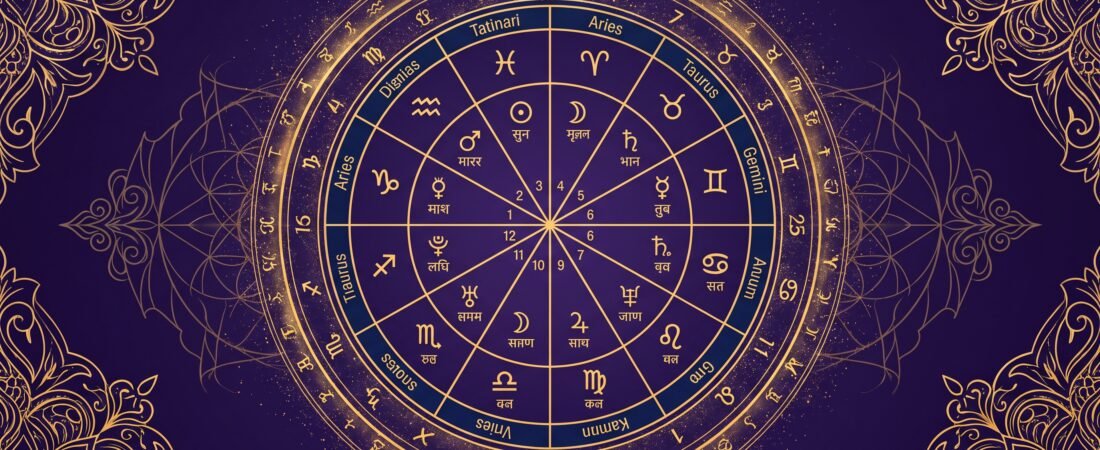
In Vedic astrology, “D” stands for “Divisional” and the number indicates how the zodiac is divided. The D1 chart is the first divisional chart — the undivided zodiac itself, showing all 12 signs in their natural 30-degree segments.
Here’s the complete divisional chart system:
| Chart | Name | Purpose | Division |
|---|---|---|---|
| D1 | Rashi (Lagna) | Overall life, personality, physical body | 12 signs (30° each) |
| D2 | Hora | Wealth, family, financial resources | 2 divisions (15° each) |
| D3 | Drekkana | Siblings, courage, initiative | 3 divisions (10° each) |
| D4 | Chaturthamsa | Home, property, mother, inner peace | 4 divisions (7.5° each) |
| D7 | Saptamsa | Children, progeny, creative expression | 7 divisions (4.29° each) |
| D9 | Navamsa | Marriage, spouse, dharma, fortune | 9 divisions (3.33° each) |
| D10 | Dashamsa | Career, profession, public status | 10 divisions (3° each) |
Notice that every chart after D1 is a subdivision of the D1 chart. The D2 Hora divides each 30-degree sign into two 15-degree parts. The D9 Navamsa divides each sign into nine 3.33-degree parts. The D1 chart is the parent; all others are children.
The 12 Houses of the D1 Chart: Your Life Map
The D1 chart is divided into 12 houses, each representing a specific life domain. The house positions are calculated from your Ascendant (Lagna), which is the zodiac sign rising on the eastern horizon at your exact birth time.
First House (Lagna Bhava): Your physical body, personality, appearance, health, vitality, and overall life direction. The sign on the first house cusp is your Ascendant sign, and its lord is the most important planet in your chart.
Second House (Dhana Bhava): Wealth, family, speech, food habits, early education, and accumulated resources. This house shows how you earn, save, and use money.
Third House (Sahaja Bhava): Siblings, courage, communication, short travels, and initiative. This house reveals your relationship with brothers and sisters, and your ability to take action.
Fourth House (Sukha Bhava): Mother, home, property, vehicles, education, and emotional security. This house shows your relationship with your mother and your connection to your homeland.
Fifth House (Putra Bhava): Children, intelligence, creativity, romance, speculation, and past-life merit. This house reveals your creative abilities and your relationship with children.
Sixth House (Ripu Bhava): Enemies, debts, diseases, service, litigation, and obstacles. This house shows the challenges you face and your ability to overcome them.
Seventh House (Kalatra Bhava): Marriage, partnerships, business relationships, foreign travel, and public image. This house reveals your approach to one-on-one relationships.
Eighth House (Ayur Bhava): Longevity, transformation, inheritance, occult knowledge, and sudden events. This house shows major life changes and your ability to handle crises.
Ninth House (Bhagya Bhava): Father, guru, fortune, dharma, higher education, and long-distance travel. This house reveals your luck, spiritual inclinations, and relationship with your father.
Tenth House (Karma Bhava): Career, profession, public status, authority, and reputation. This house shows your life’s work and your contribution to society.
Eleventh House (Labha Bhava): Gains, income, friends, social circle, and fulfillment of desires. This house reveals how you achieve your goals and the support you receive from others.
Twelfth House (Vyaya Bhava): Losses, expenses, foreign lands, liberation, sleep, and isolation. This house shows what you release and your connection to spiritual liberation.
Why the D1 Chart Is More Important Than Moon Sign or Sun Sign
Modern astrology often reduces personality to a single sign — your Sun sign in Western astrology or your Moon sign (Rashi) in Vedic astrology. While these provide useful insights, they represent only one piece of a much larger puzzle.
The Moon Sign (Rashi) tells you:
- Your emotional nature and how you process feelings
- Your mind’s natural tendencies and reactions
- Your relationship with your mother
- Your mental compatibility with others
The Sun Sign tells you:
- Your core identity and ego
- Your soul’s purpose and vitality
- Your relationship with authority figures
- Your leadership qualities
The D1 Chart tells you:
- Everything above, plus your complete life blueprint
- The timing of major life events through Dasha periods
- Your career path and professional strengths
- Your marriage compatibility and relationship patterns
- Your health vulnerabilities and strengths
- Your financial prospects and wealth-generating periods
- Your spiritual evolution and karmic patterns
The Moon sign is like knowing someone’s emotional temperament. The D1 chart is like knowing their entire life story — past, present, and future potentials.
How to Read Your D1 Chart: The Three Pillars
Reading a D1 chart can feel overwhelming at first, but it becomes manageable when you focus on three pillars:
Pillar 1: The Ascendant (Lagna)
Your Ascendant is the sign rising on the eastern horizon at your birth. It determines:
- Your physical appearance and health constitution
- Your overall life direction and personality
- The starting point for all 12 houses
- The lord of the first house (Lagna lord), who becomes the chart’s primary significator
For example, if your Ascendant is Aries, Mars is your Lagna lord. Mars’s placement in your chart shows where your energy, courage, and initiative are focused.
Pillar 2: The Moon Sign (Rashi)
Your Moon sign shows your emotional nature and mental patterns. The Moon’s placement reveals:
- Which house matters most for your emotional security
- How you process experiences and make decisions
- Your relationship with your mother and nurturing figures
- Your mental strengths and vulnerabilities
Pillar 3: The Sun Sign
Your Sun sign represents your soul’s purpose and core identity. The Sun’s placement shows:
- Where your vitality and life force are expressed
- Your relationship with authority and father figures
- Your leadership style and public image
- Your capacity for self-expression and creativity
When you understand these three pillars — Ascendant, Moon, and Sun — you can begin to interpret the rest of the chart by examining which houses they occupy and how they interact with other planets.
Planetary Positions in the D1 Chart: What They Mean
The nine planets (Navagraha) in Vedic astrology each represent specific life principles. Their placement in your D1 chart shows where these principles play out:
| Planet | Represents | Natural Significations |
|---|---|---|
| Sun (Surya) | Soul, authority, father | Government, leadership, vitality, ego |
| Moon (Chandra) | Mind, emotions, mother | Public, liquids, travel, mental peace |
| Mars (Mangal) | Energy, courage, siblings | Land, engineering, surgery, competition |
| Mercury (Budh) | Intelligence, communication | Business, education, writing, trade |
| Jupiter (Guru) | Wisdom, expansion, children | Teaching, law, religion, wealth |
| Venus (Shukra) | Love, beauty, marriage | Arts, luxury, vehicles, relationships |
| Saturn (Shani) | Discipline, karma, longevity | Service, labor, delays, structure |
| Rahu | Obsession, foreign elements | Technology, unconventional paths, illusions |
| Ketu | Detachment, spirituality | Mysticism, past lives, liberation |
When a planet is placed in a specific house, it influences that house’s domain. For example, Jupiter in the 10th house suggests career growth through teaching, advisory roles, or wisdom-based professions. Saturn in the 7th house may indicate delays or challenges in marriage but can also bring stability and maturity in partnerships over time.
Aspects and Conjunctions: How Planets Interact
Planets don’t operate in isolation. They aspect (influence) other houses and conjunct (combine with) other planets, creating complex patterns that shape your life.
Conjunctions: When two or more planets occupy the same house, their energies blend. A Sun-Mercury conjunction (Budhaditya Yoga) enhances intelligence and communication. A Mars-Saturn conjunction creates tension between action and restraint.
Aspects: Every planet aspects the house directly opposite (7th from it). Special planets have additional aspects:
- Mars aspects the 4th and 8th houses from itself
- Jupiter aspects the 5th and 9th houses from itself
- Saturn aspects the 3rd and 10th houses from itself
These aspects modify the houses and planets they touch, creating favorable or challenging patterns depending on the planets involved.
Yogas in the D1 Chart: Special Combinations
Yogas are planetary combinations that produce specific results. Some common yogas found in the D1 chart include:
- Raja Yoga: Combination of Kendra lords (1st, 4th, 7th, 10th) and Trikona lords (1st, 5th, 9th) that brings success, authority, and recognition
- Dhana Yoga: Connection between the 2nd house (wealth) and 11th house (gains) that indicates financial prosperity
- Gajakesari Yoga: Jupiter in a Kendra from the Moon that brings wisdom, reputation, and lasting success
- Budhaditya Yoga: Sun and Mercury conjunction that enhances intelligence, communication, and learning ability
- Chandra-Mangala Yoga: Moon and Mars conjunction that creates entrepreneurial energy but can also bring emotional volatility
Identifying yogas in your D1 chart reveals your natural strengths and the areas where you’re most likely to excel.
How to Generate Your D1 Chart: Step-by-Step
- Gather your birth details: You need your exact birth date, time, and place. Birth time accuracy is critical — even a 15-minute difference can change your Ascendant and house placements.
- Use a reliable Kundli generator: Astrova AI’s free Janam Kundli feature calculates your D1 chart using the Swiss Ephemeris, the gold standard for astronomical calculations in Vedic astrology.
- Review your Ascendant: This is your Lagna sign and the starting point for all house calculations.
- Note planetary positions: See which houses each planet occupies and which signs they’re in.
- Identify key patterns: Look for conjunctions, aspects, and yogas that stand out.
- Consult an astrologer or AI: For detailed interpretation, use Astrova AI’s voice chat to ask specific questions about your D1 chart.
The entire process takes less than two minutes, and you’ll have a complete D1 chart that serves as the foundation for all future astrological analysis.
Common Mistakes When Reading the D1 Chart
Mistake 1: Ignoring the Ascendant
Many people focus only on their Moon sign or Sun sign, missing the Ascendant’s critical role in determining house positions and overall life direction.
Mistake 2: Overlooking House Lords
Each house has a lord (the planet ruling the sign on that house cusp). The placement and condition of house lords are often more important than the planets actually sitting in that house.
Mistake 3: Misinterpreting Malefic Planets
Saturn, Mars, Rahu, and Ketu are often feared as “malefic,” but they can produce excellent results when well-placed. Saturn in the 10th house, for example, can bring tremendous career success through discipline and hard work.
Mistake 4: Not Considering Dasha Periods
Your D1 chart shows potentials, but those potentials activate during specific Dasha periods. A powerful Raja Yoga in your chart may not manifest until you run the Dasha of the planets involved.
Mistake 5: Using Inaccurate Birth Time
If your birth time is wrong, your entire D1 chart is wrong. Always verify your birth time with hospital records, family members, or birth certificates before doing serious astrological analysis.
📊 Get Your Complete D1 Chart
Accurate calculations, instant results
100% FREE • No credit card required
Frequently Asked Questions
1. Is the D1 chart the same as my birth chart or Janam Kundli?
Yes, the D1 Rashi chart is your birth chart, also called Janam Kundli or Lagna chart. It shows the exact positions of all planets at your birth time and serves as the foundation for all astrological analysis.
2. How is the D1 chart different from the Navamsa (D9) chart?
The D1 chart shows your overall life blueprint, while the D9 Navamsa chart specifically focuses on marriage, spouse, dharma, and fortune. The D9 is calculated by dividing each sign into nine parts, and it’s considered the most important divisional chart after D1 for predicting marriage outcomes.
3. Can I read my D1 chart without knowing astrology?
Basic interpretation is possible with guidance, but accurate D1 chart reading requires understanding of house lords, planetary strengths, aspects, yogas, and Dasha systems. For reliable insights, use AI astrology tools like Astrova or consult a qualified Vedic astrologer.
4. What if I don’t know my exact birth time?
Without an accurate birth time, your Ascendant and house positions cannot be calculated correctly. Options include: checking hospital birth records, asking family members, or using birth time rectification techniques (which require an experienced astrologer). Moon sign readings can still be done without birth time, but they’re limited.
5. How often should I review my D1 chart?
Your D1 chart doesn’t change — it’s fixed at birth. However, you should review it when you enter a new Dasha period (planetary cycle) or when major transits occur, as these activate different parts of your chart. Annual reviews help you understand the year’s themes and opportunities.
6. Can the D1 chart predict specific events like marriage date or job change?
The D1 chart shows timing patterns through Dasha periods and transits, but it doesn’t give exact dates for specific events. It reveals favorable and challenging periods, allowing you to make informed decisions. For precise timing, astrologers combine D1 analysis with divisional charts and transit analysis.
Explore More Astrova Guides
- How to Generate Your Janam Kundli Online
- Kundli Milan: Complete Marriage Compatibility Guide
- 7th House in Kundli: Marriage, Partnerships & Business
- How to Use AI Astrology for Daily Life Guidance
- Complete Guide to AI Palm Reading
About the Astrova AI Editorial Team
The Astrova AI Editorial Team creates accessible astrology content for modern life. Our guides combine traditional Vedic principles with practical applications for relationships, career, and personal growth. All content is reviewed for astrological accuracy and clarity.
Have a correction or question? We welcome feedback. Reach us at support@theastrova.com.
Related posts:
 How to read your own palm at home — step-by-step guide — Complete Guide 2026
 How to check your daily Rashifal using your Moon sign — step by step — Complete Guide 2026
 How to identify Kaalsarp Dosha in your Kundli — visual guide — Complete Guide 2026
How accurate is AI Kundli matching vs traditional astrologer matching? — Complete Guide 2026
How to identify Kaalsarp Dosha in your Kundli — visual guide — Complete Guide 2026
How accurate is AI Kundli matching vs traditional astrologer matching? — Complete Guide 2026