What Is Pitru Dosha in Your Kundli and How Does It Affect Your Family and Life?
Quick Answer: Pitru Dosha is a condition in Vedic astrology that indicates unresolved karmic debt to your ancestors (Pitrus). It forms in a kundli when specific planetary combinations — most commonly involving the Sun, Moon, Rahu, Ketu or Saturn in the 9th house — suggest that ancestral rituals were neglected, ancestors died unnaturally, or family traditions were broken. Classical texts recommend Tarpan, Shraddha and Pitra Paksha observances as remedies. While the dosha is taken seriously in traditional Jyotish, its effects are understood as karmic patterns that can be addressed through conscious spiritual practice.
100% FREE • AI Astrology
Get Your Free Reading Now
Palm Reading • Kundli • Rashifal • Kundli Milan • AI Astrologer
What Are the Pitrus in Vedic Astrology?
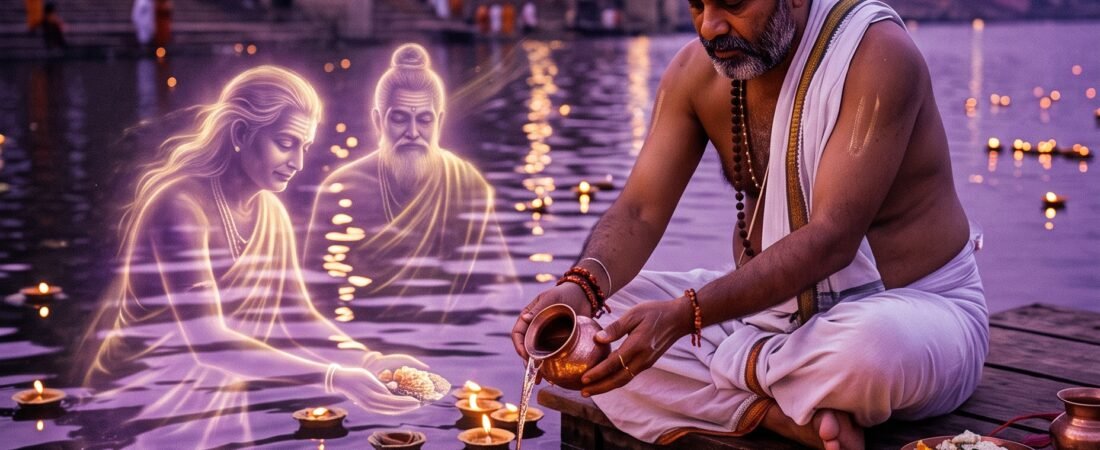
In Vedic cosmology, the Pitrus are the ancestral spirits — the departed souls of your forefathers and foremothers. They occupy a specific plane of existence between the earthly realm and the divine. The Garuda Purana and Manusmriti both describe the Pitrus as beings who can bless or withhold blessings from their living descendants, depending on whether proper rites are performed.
The 9th house of your kundli represents your father, paternal lineage, dharma (righteousness) and the blessings you inherit from past generations. When malefic planets afflict this house — or when the Sun (karaka for the father) is weak or afflicted — astrologers examine the chart for Pitru Dosha.
How Is Pitru Dosha Formed in a Kundli?
Classical texts describe several planetary combinations that indicate Pitru Dosha:
| Planetary Combination | Traditional Interpretation |
|---|---|
| Rahu in 9th house | Ancestors who died unnaturally or without proper last rites |
| Ketu in 9th house | Ancestral line disruption, unknown or forgotten ancestors |
| Saturn in 9th house | Neglected Shraddha ceremonies, ancestral displeasure |
| Sun afflicted by Rahu/Ketu | Father’s karmic burden passed to native |
| Moon afflicted in 9th house | Emotional patterns inherited from ancestral trauma |
| Sun + Saturn conjunction | Father-ancestor karma conflict, authority struggles |
| 9th lord in 6th, 8th or 12th house | Ancestral blessings blocked by other karmic factors |
It is important to note: having one of these combinations does not automatically mean severe consequences. Astrology works through the totality of the chart — strength of the 9th lord, aspects from benefics, Dasha periods and divisional charts (especially the D9 Navamsa) all modify the picture.
What Effects Does Pitru Dosha Traditionally Have?
According to classical Jyotish interpretation, unresolved Pitru Dosha may manifest as recurring patterns in a family:
- Health challenges that run in families without clear medical explanation
- Difficulty conceiving or repeated pregnancy complications across generations
- Financial instability that seems to repeat in cycles regardless of effort
- Family discord — persistent arguments, estrangement between fathers and children
- Obstacles in education or career that appear at specific life stages
- Recurring dreams of deceased ancestors, especially those requesting something
Again, these are traditional interpretations — not medical diagnoses or guaranteed outcomes. Many people with these planetary combinations live perfectly healthy, prosperous lives. The dosha framework is meant to highlight areas for spiritual attention, not to create fear.
The Research Perspective: What Can We Verify?
It is worth being transparent about what is and is not empirically verifiable about Pitru Dosha:
- What is documented: The planetary combinations described above are consistent across classical texts — Brihat Parashara Hora Shastra, Phaladeepika by Mantreswara, and Jataka Parijata all reference ancestral karma indicators.
- What is cultural practice: Pitra Paksha (the fortnight of ancestors observed in Bhadrapada month), Tarpan (water offerings), and Shraddha ceremonies are living traditions practiced by millions of Hindu families. Their spiritual value is a matter of faith.
- What is not scientifically verified: No peer-reviewed study has demonstrated that planetary positions at birth cause the family patterns described above. The correlations are astrological, not statistical.
Being honest about these distinctions strengthens your understanding rather than weakening it. You can respect the tradition while maintaining intellectual clarity.
Traditional Remedies for Pitru Dosha
Classical texts recommend several remedies. These are drawn from the Garuda Purana and common practice:
- Tarpan during Pitra Paksha — Offering water mixed with black sesame seeds to ancestors during the 16-lunar-day fortnight (usually September–October) while chanting the Pitru Gayatri mantra.
- Shraddha ceremony — Performing the annual death anniversary ritual with proper Vedic mantras, feeding Brahmins or the poor, and offering pinda (rice balls).
- Visit to sacred sites — Gaya (Bihar), Varanasi, Nashik and Haridwar are considered especially powerful for ancestral rites.
- Donation in ancestors’ name — Giving food, clothing or money to the needy on Amavasya (new moon day) and on the death anniversary (tithi) of departed family members.
- Recitation of Garuda Purana — Reading or listening to the Garuda Purana, particularly the sections on ancestral rites, during the Pitru Paksha period.
- Sun worship — Offering water to the Sun every morning (Surya Arghya) with the mantra “Om Suryaya Namaha” strengthens the Sun, which is the karaka for the father and paternal lineage.
How to Check for Pitru Dosha in Your Kundli
To identify whether your chart shows Pitru Dosha indicators, you need:
- Your exact birth date, time and place
- A complete kundli showing the 9th house, its lord, and the positions of Sun, Moon, Rahu, Ketu and Saturn
- Analysis of the D9 (Navamsa) chart for ancestral patterns
Astrova’s free kundli generator creates your complete birth chart with all planetary positions. You can then check the 9th house placements against the table above. For deeper analysis, Astrova’s AI astrology tool can interpret the combinations in context.
100% FREE • AI Astrology
Get Your Free Reading Now
Palm Reading • Kundli • Rashifal • Kundli Milan • AI Astrologer
Frequently Asked Questions
1. Is Pitru Dosha dangerous?
The word “dosha” literally means “fault” or “imbalance” — not “danger.” In Vedic astrology, Pitru Dosha indicates an area of karmic attention, not a curse. Many people with these planetary combinations live fulfilling lives. The dosha framework is a spiritual lens for self-reflection, not a prediction of harm.
2. Can Pitru Dosha be completely removed?
Traditional texts say the dosha is “pacified” (shanti) rather than removed. The remedies — Tarpan, Shraddha, donations, sacred site visits — are understood to address the karmic imbalance over time. Regular practice during Pitra Paksha is considered the most effective approach.
3. Does Pitru Dosha affect marriage?
In traditional interpretation, severe Pitru Dosha can be a factor in kundli milan (marriage compatibility analysis). Some families check for it alongside Manglik Dosha and Nadi Dosha. However, most astrologers consider it a secondary factor that can be addressed through remedies.
4. What is Pitra Paksha and when does it occur?
Pitra Paksha is a 16-lunar-day period dedicated to ancestor worship. It falls in the Hindu month of Bhadrapada (typically September–October), ending on Sarvapitri Amavasya. In 2026, Pitra Paksha is expected to run from approximately September 21 to October 5.
5. Can Astrova AI detect Pitru Dosha in my chart?
Astrova AI can generate your complete kundli showing all planetary positions, including the 9th house, Sun, Rahu, Ketu and Saturn placements. You can cross-reference these with the combinations listed in this article. For a guided interpretation, use the AI astrologer chat feature.
Explore More Astrova Guides
About the Astrova AI Editorial Team
The Astrova AI Editorial Team combines traditional Vedic astrology knowledge with modern AI technology to create accessible, practical astrology content. Our goal is to help you understand your chart and make informed decisions.
Related posts:
 How to read your own palm at home — step-by-step guide — Complete Guide 2026
 How to check your daily Rashifal using your Moon sign — step by step — Complete Guide 2026
 How to identify Kaalsarp Dosha in your Kundli — visual guide — Complete Guide 2026
How accurate is AI Kundli matching vs traditional astrologer matching? — Complete Guide 2026
How to identify Kaalsarp Dosha in your Kundli — visual guide — Complete Guide 2026
How accurate is AI Kundli matching vs traditional astrologer matching? — Complete Guide 2026