🔮 100% FREE — AI Astrology Reading
Discover what Hanuman and Shani mean for YOUR birth chart
How Did Lord Hanuman Free Shani (Saturn) From Ravana’s Prison? The Devotion Story Behind Your Sade Sati Remedy
Quick Answer: According to Hindu mythology, Lord Hanuman freed Lord Shani (the planet Saturn) from imprisonment by the demon king Ravana during the period when Shani was transiting through Leo — the sign of the Sun. Hanuman’s act of devotion and mercy toward Shani established one of the most powerful astrological remedies in Vedic astrology: worshipping Hanuman during Sade Sati and Shani Dasha to receive relief from Saturn’s karmic lessons.
If you have ever felt the weight of Saturn’s transit — the delays, the isolation, the relentless pressure to grow — you are not alone. Every person who passes through Sade Sati or Shani Dasha walks through the same cosmic fire that Shani himself once walked through. And the story of how Hanuman came to his rescue is one of the most remarkable chapters in Vedic mythology.
The Story: When Shani Was Imprisoned by Ravana
The legend appears in multiple Puranic sources, including the Shani Mahatmya section of the Brahma Vaivarta Purana and various regional retellings of the Ramayana tradition. While details vary across versions, the core narrative is consistent:
During the Treta Yuga, when Ravana ruled Lanka at the height of his power, he performed severe penance to please Lord Shani. Pleased by Ravana’s austerity, Shani granted him a boon. But Ravana, in his arrogance, demanded that Shani remain in Lanka as his personal planetary deity — essentially imprisoning the lord of karma.
Shani, bound by the boon, was forced to stay in Lanka. But cosmic order demanded that Saturn continue its transit through the zodiac. When Shani refused to leave Lanka, the planetary balance of the universe was disrupted. Seasons stopped changing. Crops failed. The natural rhythm of time itself began to fracture.
It was during this cosmic crisis that Lord Hanuman — the ultimate devotee of Lord Rama — encountered Shani’s plight.
Hanuman’s Encounter With Shani
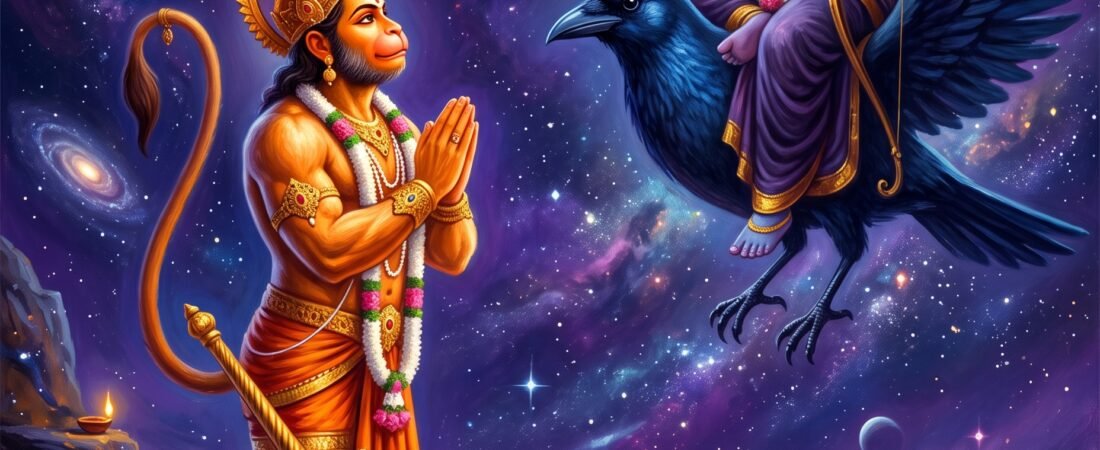
The most widely told version describes Hanuman flying over Lanka during his search for Sita. As he passed above the island, he sensed an extraordinary disturbance — a planetary deity trapped against cosmic law. Hanuman descended and found Shani confined in a chamber of Ravana’s palace.
What happened next reveals something profound about the relationship between these two deities. Hanuman did not attack Shani or treat him as an enemy. Instead, he recognised that Shani — the planet of karma, discipline and spiritual growth — was himself a devotee of Lord Rama. Shani had been imprisoned precisely because he refused to compromise cosmic dharma, even under Ravana’s command.
Hanuman, understanding that Shani was a fellow servant of the divine, challenged Ravana’s hold over the planet. In some versions, Hanuman physically confronted Ravana’s guards. In others, he simply carried Shani away on his back, flying him to safety. The most poetic retelling describes Hanuman leaping from Lanka with Shani on his shoulders, just as he had once carried the Sanjeevani mountain.
The Promise: Hanuman’s Protection During Shani’s Transit
After freeing Shani, a remarkable exchange took place. Grateful for his liberation, Shani asked Hanuman what boon he desired. Hanuman, ever the selfless devotee, asked for nothing for himself. Instead, he made a request on behalf of all human beings:
“Anyone who remembers the story of our meeting, or who worships me during your transit through their birth chart, should receive relief from the harshest effects of your karma.”
Shani agreed. And this is why, across thousands of years of Vedic astrological practice, Hanuman worship has remained the single most recommended remedy for anyone going through Sade Sati, Shani Dasha, or any difficult Saturn transit.
The Astrological Significance: Why Hanuman Worship Works for Saturn
To understand why this remedy is considered so effective, you need to understand what Saturn represents in Vedic astrology and why Hanuman’s energy directly counterbalances it.
| Quality | Saturn (Shani) | Hanuman |
|---|---|---|
| Energy | Restriction, delay, discipline | Unlimited strength, speed, devotion |
| Effect on life | Creates obstacles and karmic lessons | Removes obstacles through grace |
| Temperament | Strict, impartial, karmic judge | Compassionate, protective, merciful |
| Relationship to devotees | Tests faith through suffering | Shields devotees from excessive suffering |
| Symbolic role | The teacher who forces growth | The protector who makes growth bearable |
In astrological terms, Saturn is a karaka (significator) of karma, duty, time and limitation. Hanuman, as an avatar of Shiva’s Rudra aspect and the supreme devotee of Rama (Vishnu’s avatar), carries the energy of selfless service (seva), courage and divine grace. When you invoke Hanuman during a Saturn transit, you are not bypassing karma — you are asking for the strength and protection to pass through it without being broken.
How to Use This Story as a Practical Remedy
The Hanuman-Shani connection is not merely a mythological curiosity. It forms the basis of several widely practised Vedic remedies that astrologers recommend during difficult Saturn periods. Here are the most commonly prescribed practices, drawn from traditional Jyotish guidance:
- Recite the Hanuman Chalisa on Saturdays. Saturday is Saturn’s day. The Hanuman Chalisa, composed by Tulsidas in the 16th century, contains specific verses that reference Hanuman’s power over planetary afflictions. Verse 18 (“Bhoot pishach nikat nahi aave”) is traditionally understood to invoke protection from negative karmic influences, including Saturn’s malefic effects.
- Offer sindoor (vermillion) and oil at a Hanuman temple. The tradition of offering sindoor to Hanuman on Saturdays is directly connected to the Shani story. According to one retelling, Hanuman once covered his entire body with sindoor to protect Lord Rama’s long life — and Shani, recognising this supreme devotion, declared that anyone who offered sindoor to Hanuman would receive relief from Saturn’s harsh transit.
- Chant Shani’s beeja mantra alongside Hanuman’s name. The combination “Om Sham Shanaishcharaya Namah” (Shani’s mantra) followed by “Om Hanumate Namah” is considered particularly effective because it addresses both the karmic source (Saturn) and the protective grace (Hanuman) simultaneously.
- Light a sesame oil lamp under a Peepal tree on Saturday evening. The Peepal tree is associated with Saturn in Vedic astrology, and sesame oil is Saturn’s preferred offering. Doing this while remembering Hanuman’s protection combines both energies.
- Practice selfless service (seva) on Saturdays. Since Hanuman’s defining quality is selfless devotion, any act of genuine service — feeding the hungry, helping the elderly, caring for animals — performed on Saturday with Hanuman’s name in your heart is considered a powerful Saturn remedy.
What Does This Mean for Your Birth Chart?
If you are currently experiencing Sade Sati (Saturn transiting over your Moon sign), Shani Dasha (Saturn’s major period in your Vimshottari cycle), or even Shani Dhaiya (Saturn transiting the 4th or 8th house from your Moon), this story carries a practical message:
Saturn’s transit is not punishment. It is a karmic classroom. The lessons Saturn teaches — patience, humility, self-reliance, the difference between what you want and what you need — are the same lessons that forged Hanuman himself. Hanuman’s service to Rama was not easy. He faced oceans, demons, the loss of Sita, the burning of Lanka, and the death of his own beloved Lord. Every one of those trials was a Saturn-like test. And Hanuman passed every one.
When you worship Hanuman during a difficult Saturn period, you are not asking Saturn to go away. You are asking for Hanuman’s qualities — courage, devotion, selfless strength — to carry you through what Saturn is asking you to learn.
How Astrova AI Can Help You Understand Your Saturn Transit
Knowing the mythology is powerful, but knowing exactly where Saturn sits in YOUR birth chart — which house it occupies, which signs it is transiting through, and when the transit ends — is what turns spiritual wisdom into practical guidance.
Astrova AI gives you free access to:
- Complete Janam Kundli — your birth chart with Saturn’s exact house placement and aspects
- Sade Sati checker — instant identification of whether you are currently in Sade Sati and which phase you are in
- Dasha timeline — your complete Vimshottari Dasha sequence showing when Shani Mahadasha and Antardasha periods occur
- AI Astrologer chat — ask specific questions about your Saturn transit and receive personalised guidance 24/7
- Daily Rashifal — daily horoscope readings that track Saturn’s ongoing transit effects on your sign
All of this is available in the Astrova AI app, completely free, in 9 Indian languages.
⭐ 100% FREE — No Credit Card Required
Get your free Kundli and check your Saturn transit right now
Frequently Asked Questions
1. Why is Saturday considered the best day for Hanuman worship during Sade Sati?
Saturday (Shaniwar) is ruled by Saturn. In Vedic astrology, each day of the week is governed by a specific planet, and Saturday is Shani’s day. Performing Hanuman worship on this day aligns the remedy with the planetary energy that needs balancing, making the remedial effect more targeted.
2. Can women recite the Hanuman Chalisa during Sade Sati?
Yes. The Hanuman Chalisa is a universal devotional text composed by Tulsidas, and there are no scriptural restrictions on who may recite it. Women going through Sade Sati, Shani Dasha or any Saturn transit are encouraged to recite it regularly, particularly on Saturdays.
3. How long does Sade Sati last, and when should I start Hanuman remedies?
Sade Sati lasts approximately 7.5 years, divided into three phases of roughly 2.5 years each. The first phase begins when Saturn enters the sign immediately before your Moon sign, the second phase when it enters your Moon sign itself, and the third when it enters the sign after. You can start Hanuman remedies at any point during this period — the earlier, the better.
4. Is Hanuman worship the only remedy for Saturn’s malefic effects?
No. Vedic astrology offers multiple remedies for Saturn afflictions, including wearing a blue sapphire (after proper astrological consultation), donating black sesame seeds or iron on Saturdays, fasting on Saturdays, and reciting Shani Stotra. However, Hanuman worship is considered the safest and most universally recommended remedy because it does not require gemstone testing and carries no risk of aggravating Saturn if done incorrectly.
5. What is the connection between Hanuman and Saturn in terms of their planetary positions?
In Vedic astrology, Hanuman is associated with Mars (for his courage and warrior energy) and also with the Rudra aspect of Shiva. Saturn, as the planet of karma and discipline, respects devotion and selfless service above all else. When Mars energy (Hanuman) and Saturn energy (Shani) work together through devotion, they create a powerful combination of action and discipline that can overcome even the most difficult karmic patterns.
Explore More Astrova Guides
- Vishnu’s 10 Avatars and the Navagraha Planets
- What Is Sade Sati and How to Check It in Your Kundli
- Vedic Planetary Remedies — Navagraha Guide
- AI Palm Reading Complete Guide
- How to Generate Janam Kundli Online Free
References and Sources
- Brahma Vaivarta Purana, Shani Mahatmya section — the primary Puranic source for the Hanuman-Shani liberation story
- Tulsidas, Hanuman Chalisa (16th century) — the devotional text whose verses are recited as Saturn remedies
- B.V. Raman, Effects of Sade Sati and How to Mitigate Them (Sagar Publications) — classical Jyotish reference on Saturn transit remedies
- Drik Panchang (drikpanchang.com) — for Saturn transit dates and Sade Sati calculations
🙏 Start Your Free Astrology Journey Today
Kundli • Rashifal • Palm Reading • AI Astrologer — All Free
About the Astrova AI Editorial Team
The Astrova AI Editorial Team creates content that makes Vedic astrology accessible to everyone. Our guides draw from classical Jyotish traditions and are designed to help you understand your birth chart, navigate planetary transits, and use astrology as a tool for self-awareness and growth.
Related posts:
 What Is the Bhrigu Samhita — The Ancient Palm Leaves That Predict Your Destiny?
 What Does Your Marriage Line on the Palm Reveal About Your Love Life and Relationship Timing?
 What Is Kemadruma Yoga In Your Kundli And Does It Really Cause Poverty?
 What Is Ashtakavarga in Vedic Astrology and How Does This Point System Predict Planetary Strength