Who Is Lord Dattatreya? The Combined Avatar of Brahma, Vishnu & Shiva in Vedic Tradition
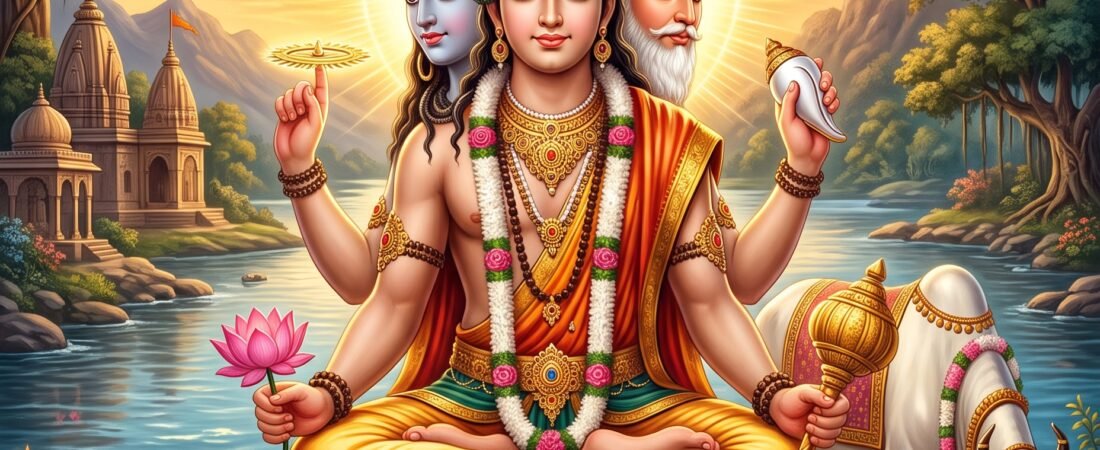
Quick Answer: Lord Dattatreya is a unique Hindu deity who embodies the combined form of the Trimurti — Brahma (the Creator), Vishnu (the Preserver), and Shiva (the Transformer). He is depicted with three heads and four arms, accompanied by four dogs (representing the four Vedas) and a cow (representing Mother Earth). In Vedic astrology, Dattatreya is associated with Jupiter and the concept of the divine guru who dispels ignorance and bestows spiritual wisdom.
✨ 100% FREE — No Credit Card Required
Discover Your Spiritual Path with Astrova AI
AI Kundli • Daily Rashifal • Palm Reading • 24/7 AI Astrologer
The Origin Story of Lord Dattatreya
The story of Dattatreya’s birth is one of the most remarkable narratives in Hindu mythology. According to the Puranas, the sage Atri and his wife Anasuya were performing intense tapasya (austerities) on the banks of the river Narmada. Their devotion was so powerful that it alarmed the gods, who feared the sage might surpass them in spiritual power.
The Trimurti — Brahma, Vishnu, and Shiva — decided to test Anasuya’s chastity and devotion. They appeared before her in the guise of wandering ascetics, begging for alms at a time when Atri was away. Anasuya, known for her unwavering virtue, welcomed them with respect. However, the three gods demanded that she serve them food while completely naked, testing her resolve.
Anasuya’s devotion was unshaken. Through her spiritual power, she transformed the three gods into three infants and nursed them as her own child. When Atri returned and learned of this, he was pleased by his wife’s purity and the divine blessing. The Trimurti, revealing their true forms, offered Anasuya a boon: they would be reborn as her son, unified in a single form. Thus, Dattatreya was born — “Datta” meaning “given” and “Atreya” meaning “son of Atri.”
The Symbolism of Dattatreya’s Form
Every element of Lord Dattatreya’s iconography carries deep spiritual and astrological significance:
| Symbol | Meaning | Astrological Connection |
|---|---|---|
| Three Heads | Brahma, Vishnu, Shiva — creation, preservation, transformation | Represents the three gunas: Sattva, Rajas, Tamas |
| Four Arms | Conch (sound/creation), discus (time), mace (power), lotus (purity) | Vishnu’s attributes — preservation of cosmic order (dharma) |
| Four Dogs | The four Vedas — Rig, Sama, Yajur, Atharva | Jupiter’s domain — sacred knowledge and wisdom |
| Cow (Kamadhenu) | Mother Earth, selfless giving, nourishment | Venus — generosity, abundance, nurturing |
| Wish-Fulfilling Tree | Kalpavriksha — the tree that grants all desires | Jupiter’s benevolence — spiritual and material boons |
Dattatreya in Vedic Astrology: The Jupiter Connection
In Jyotish (Vedic astrology), Lord Dattatreya is closely associated with Jupiter (Brihaspati) — the planet of wisdom, spirituality, teaching, and divine grace. Jupiter is considered the guru of the gods, and Dattatreya is considered the guru of gurus, making this connection deeply significant.
When Jupiter is strong in a birth chart (placed in its own signs Sagittarius or Pisces, or exalted in Cancer), the native often shows Dattatreya-like qualities: a natural inclination toward teaching, spiritual wisdom, generosity, and the ability to guide others. Conversely, a weak or afflicted Jupiter may indicate a need to seek the Dattatreya principle — to find a true guru or to develop the inner wisdom that Dattatreya represents.
Astrologers often recommend Dattatreya worship or meditation during Jupiter Dasha (the planetary period ruled by Jupiter) or when Jupiter transits through significant houses in the kundli. The Dattatreya mantra — “Om Shri Gurudev Datta” — is chanted to strengthen Jupiter’s influence and invite divine guidance into one’s life.
The 24 Gurus of Dattatreya: Wisdom from All of Nature
One of the most profound teachings attributed to Dattatreya comes from the Bhagavata Purana (Book XI, Chapter 7). When asked by the king Yadu about the source of his supreme wisdom, Dattatreya revealed that he had 24 gurus — drawn not from human teachers alone, but from every element of nature.
His 24 gurus included:
- The Earth — taught patience and forbearance; the earth bears all burdens without complaint
- The Wind — taught detachment; the wind moves everywhere but is attached to nothing
- Fire — taught purity; fire burns everything it touches but remains uncontaminated
- Water — taught compassion and clarity; water purifies all and is sweet to everyone
- The Spider — taught how the universe is woven from the self, just as a spider spins its web from its own body
- The Bee — taught moderation; the bee takes small amounts from many flowers without harming any
- The Ocean — taught depth and equanimity; the ocean remains unchanged regardless of what rivers flow into it
- A Child — taught innocence and joy; a child is happy without reason
This teaching carries a powerful astrological message: wisdom is not confined to one planet, one house, or one guru. The entire cosmos is a teacher for those who observe with awareness. This principle aligns with the Vedic understanding that every planetary placement in a kundli offers a lesson — Saturn teaches discipline, Mars teaches courage, Mercury teaches discernment, and so on.
Dattatreya Jayanti: When and How to Observe It
Dattatreya Jayanti, the birth anniversary of Lord Dattatreya, is celebrated on Shukla Purnima (full moon day) of the Margashirsha month in the Hindu calendar, which typically falls in November or December of the Gregorian calendar.
On this day, devotees observe the following practices:
- Fasting — many devotees observe a full-day fast, breaking it only after evening puja
- Mantra chanting — the Dattatreya Gayatri mantra and “Om Shri Gurudev Datta” are chanted 108 times
- Reading the Avadhuta Gita — Dattatreya’s own philosophical text, a dialogue between him and his disciple
- Feeding cows and dogs — since the cow and four dogs are sacred to Dattatreya, feeding them is considered especially meritorious
- Visiting Dattatreya temples — major temples include those at Ganagapura (Karnataka), Manikpur (Maharashtra), and the Dattatreya temple in Pushkar (Rajasthan)
From an astrological perspective, performing Dattatreya puja on Dattatreya Jayanti is believed to strengthen Jupiter’s influence in the birth chart, bringing wisdom, spiritual growth, and the guidance of a true guru.
The Avadhuta Gita: Dattatreya’s Song of Freedom
Dattatreya is credited with authoring the Avadhuta Gita — literally, the “Song of the Free Spirit.” This philosophical text, composed in Sanskrit, presents the essence of Advaita Vedanta (non-dual philosophy) in a direct, uncompromising style.
Unlike the Bhagavad Gita, which is set on a battlefield and addresses the moral dilemmas of action, the Avadhuta Gita speaks from the standpoint of absolute liberation. Its opening verse is striking:
“By the grace of the Self, I have no desire for anything. I am beyond the mind. I am infinite consciousness. I am the eternal witness of all. I am the bliss of the absolute.”
For astrology practitioners, the Avadhuta Gita offers a perspective that transcends the chart itself. While a kundli maps the karmic patterns of an individual, Dattatreya’s teaching points to the consciousness that witnesses those patterns — the awareness that is untouched by planetary influences. This is the ultimate purpose of Jyotish: not merely to predict events, but to help the seeker recognize the eternal Self that exists beyond all cosmic cycles.
Dattatreya Remedies in Vedic Astrology
Vedic astrology prescribes several remedies connected to Lord Dattatreya for strengthening Jupiter, overcoming ignorance, and receiving divine guidance:
| Remedy | When to Perform | Expected Benefit |
|---|---|---|
| Chant “Om Shri Gurudev Datta” 108 times daily | Every day, especially Thursdays | Strengthens Jupiter; brings wisdom and clarity |
| Feed cows and dogs on Purnima (full moon) | Every full moon day | Pleases Dattatreya; removes obstacles in education and career |
| Wear a yellow sapphire (Pukhraj) after astrological consultation | Only after checking Jupiter’s placement in your kundli | Amplifies Jupiter’s positive influence |
| Read or listen to the Avadhuta Gita on Dattatreya Jayanti | Margashirsha Purnima (Nov-Dec) | Spiritual liberation; detachment from material suffering |
✨ 100% FREE — No Credit Card Required
Explore Your Jupiter Placement with Astrova AI
Get your free Janam Kundli and understand Jupiter’s role in your chart
How Astrova AI Helps You Understand Planetary Influences
Understanding the mythological and astrological significance of deities like Dattatreya is only the first step. To apply this wisdom to your own life, you need to know how Jupiter — and every other planet — is placed in your birth chart.
Astrova AI makes this accessible to everyone, regardless of their astrology background:
- AI Janam Kundli — Generate your complete birth chart in seconds, with detailed planetary positions and house placements explained in plain language
- Daily Rashifal — Receive personalized daily horoscopes based on your Moon sign, including transit guidance for each planet
- AI Palm Reading — Scan your palm with your phone’s camera and receive an AI-powered analysis of your life lines, heart line, and destiny line
- Kundli Milan — Check compatibility with a partner through the traditional Ashtakoot Guna Milan system
- 24/7 AI Astrologer — Ask any astrology question and receive instant, personalized answers from an AI trained in Vedic astrology principles
- Available in 9 Indian Languages — Hindi, Tamil, Telugu, Kannada, Malayalam, Bengali, Marathi, Gujarati, and English
Frequently Asked Questions
1. Why does Dattatreya have three heads?
Dattatreya’s three heads represent the Trimurti — Brahma (the Creator), Vishnu (the Preserver), and Shiva (the Transformer). This symbolizes the belief that all three cosmic functions are unified in a single divine consciousness, and that creation, preservation, and destruction are not separate processes but aspects of one continuous reality.
2. What is the connection between Dattatreya and Jupiter in astrology?
Dattatreya is associated with Jupiter because both represent the principle of the guru — the divine teacher who dispels ignorance. Jupiter is called Brihaspati (guru of the gods) in Vedic astrology, and Dattatreya is considered the guru of all gurus. Worshipping Dattatreya is believed to strengthen a weak Jupiter in the birth chart.
3. When is Dattatreya Jayanti celebrated?
Dattatreya Jayanti falls on the full moon day (Purnima) of the Hindu month Margashirsha, which corresponds to November or December in the Gregorian calendar. In 2026, Dattatreya Jayanti is expected to fall in early December.
4. Can I worship Dattatreya if I don’t know my birth chart?
Yes. Dattatreya worship is open to everyone, regardless of astrological knowledge. However, if you want to understand how Jupiter’s placement in your specific chart affects your spiritual journey, generating a Janam Kundli (birth chart) is the traditional first step. Astrova AI offers free kundli generation with detailed planetary analysis.
5. What is the most powerful Dattatreya mantra?
The most widely chanted Dattatreya mantra is “Om Shri Gurudev Datta” (ॐ श्री गुरुदेव दत्त). It is typically chanted 108 times using a rudraksha mala, preferably on Thursdays or during Jupiter Dasha. The Dattatreya Gayatri mantra is another powerful option for those seeking deeper spiritual practice.
Explore More Astrova Guides
- AI Palm Reading: Complete Guide to Reading Your Own Palm
- How to Generate Your Janam Kundli Online for Free
- What Is Sade Sati and How to Check It in Your Kundli
- Kundli Milan: How to Check Marriage Compatibility
- How to Use AI Astrology for Daily Life Guidance
About the Astrova AI Editorial Team
The Astrova AI Editorial Team is dedicated to making Vedic astrology accessible to everyone through the power of artificial intelligence. Our content draws from widely respected Jyotish traditions and is designed to help you understand your birth chart, planetary transits, and spiritual path with clarity and confidence.
Related posts:
 How to read your own palm at home — step-by-step guide — Complete Guide 2026
 How to check your daily Rashifal using your Moon sign — step by step — Complete Guide 2026
 How to identify Kaalsarp Dosha in your Kundli — visual guide — Complete Guide 2026
How accurate is AI Kundli matching vs traditional astrologer matching? — Complete Guide 2026
How to identify Kaalsarp Dosha in your Kundli — visual guide — Complete Guide 2026
How accurate is AI Kundli matching vs traditional astrologer matching? — Complete Guide 2026