
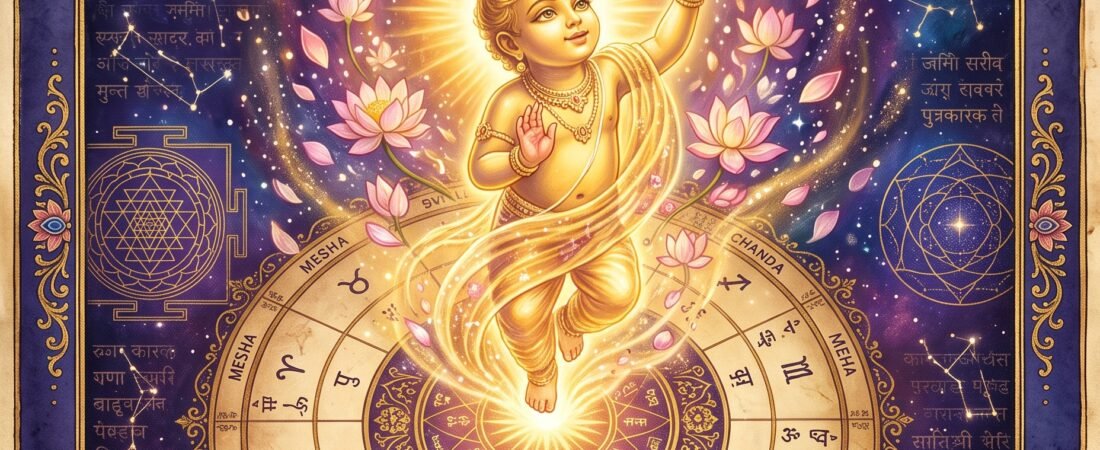
What Is Putrakaraka in Jaimini Astrology and How Does It Influence Your Children?
Quick Answer: Putrakaraka is one of the seven Chara Karakas in Jaimini astrology — the significator planet that represents children, progeny, and your relationship with them. The planet with the second-lowest degree in your birth chart (excluding Rahu/Ketu) becomes your Putrakaraka, revealing the nature of your children, timing of childbirth, and the karmic bond you share.
Get Your Free Astrology Reading
AI-powered palm reading, Janam Kundli, daily Rashifal & 24/7 astrologer chat
⭐ No credit card required • 9 Indian languages
While Parashara’s system uses the 5th house and its lord for children, Jaimini’s Jaimini Sutras introduces a parallel framework through Chara Karakas — movable significators assigned by planetary degrees. Putrakaraka (Putra = child, Karaka = significator) is central to understanding progeny matters in this system.
How to Find Your Putrakaraka Planet
The seven Chara Karakas are assigned by planetary degrees (excluding Rahu and Ketu in the standard Parashari-Jaimini synthesis):
| Karaka | Signifies | Degree Position |
|---|---|---|
| Atmakaraka | Soul, self | Highest degree |
| Amatyakaraka | Career, purpose | 2nd highest |
| Bhratrikaraka | Siblings | 3rd highest |
| Matrikaraka | Mother | 4th highest |
| Pitrikaraka | Father | 5th highest |
| Putrakaraka | Children | 2nd lowest |
| GnatiKaraka | Obstacles | Lowest |
Example: If your Mars is at 12° and Venus at 15° (with all other planets higher), Mars becomes your Putrakaraka because it holds the second-lowest degree position.
What Each Planet as Putrakaraka Reveals
- Sun as Putrakaraka: Children with strong leadership qualities, possibly born during a period of career growth. Relationship may involve lessons around authority and independence.
- Moon as Putrakaraka: Emotionally nurturing children, strong mother-child bond. Childbirth timing often linked to Moon dashas or transits through water signs.
- Mars as Putrakaraka: Energetic, courageous children. May indicate surgical birth or childbirth during a Mangal dasha. Children may have athletic or technical inclinations.
- Mercury as Putrakaraka: Intellectually gifted children, strong communication bond. Often indicates children born during Mercury or Jupiter periods.
- Jupiter as Putrakaraka: Considered highly auspicious — wise, dharmic children. Strong karmic bond, children may become sources of wisdom or spiritual growth.
- Venus as Putrakaraka: Creative, artistic children. Beautiful relationship, possible childbirth during Venus dasha or in Taurus/Libra.
- Saturn as Putrakaraka: Mature, responsible children. May indicate delay in childbirth or children born during Saturn dasha. Relationship deepens over time.
Putrakaraka and Timing of Children
Jaimini astrology uses the Putrakaraka’s dasha and antardasha periods, along with its transit positions, to time childbirth. Key principles from Jaimini Sutras:
- The dasha of the Putrakaraka planet often brings childbirth or significant events related to children.
- When the Putrakaraka transits or aspects the 5th house from Karakamsa (the sign holding Atmakaraka in Navamsa), progeny events activate.
- Jupiter’s transit over or aspecting the Putrakaraka during its dasha is considered especially favorable for childbirth.
How Astrova AI Helps You Understand Putrakaraka
Astrova AI’s Janam Kundli generator calculates all seven Chara Karakas automatically, identifying your Putrakaraka planet and explaining its significance in plain language. The AI astrologer can answer specific questions like “What does my Putrakaraka say about my children?” or “When is the best time for childbirth based on my chart?”
Get Your Free Astrology Reading
AI-powered palm reading, Janam Kundli, daily Rashifal & 24/7 astrologer chat
⭐ No credit card required • 9 Indian languages
Putrakaraka vs. 5th House: Which System to Follow?
Both systems are valid and complementary. Parashara’s 5th house analysis gives the structural foundation, while Jaimini’s Putrakaraka adds nuance about the quality of the parent-child relationship and the karmic nature of the children. Experienced astrologers often read both together for a complete picture.
📚 Explore More Astrova Guides
Frequently Asked Questions
Q1: How is Putrakaraka different from the 5th house lord?
The 5th house lord shows the general promise of children, while Putrakaraka (the planet with second-lowest degree) specifically signifies the children themselves and the nature of your relationship with them.
Q2: Can Putrakaraka change over time?
No. Putrakaraka is fixed at birth based on planetary degrees. Unlike dashas that shift, your Karakas remain constant throughout life, representing your karmic blueprint.
Q3: What if Rahu or Ketu has the second-lowest degree?
In the standard Parashari-Jaimini synthesis, Rahu and Ketu are excluded from Chara Karaka assignment. The seven visible planets (Sun through Saturn) take the seven Karaka positions.
Q4: Does a weak Putrakaraka mean no children?
Not at all. A debilitated or afflicted Putrakaraka may indicate delays, challenges, or a complex relationship — but it does not deny progeny. Remedies, dasha timing, and overall chart strength matter more.
Q5: How can I find my Putrakaraka planet?
You need your exact birth time to calculate planetary degrees. Astrova AI’s free Janam Kundli feature calculates all seven Chara Karakas instantly and explains what each means for your life.
About the Astrova AI Editorial Team
The Astrova AI Editorial Team combines traditional Vedic astrology scholarship with modern AI technology. Our content draws from classical Jyotish texts including Brihat Parashara Hora Shastra, Jaimini Sutras, and Phaladeepika, verified against contemporary astrological practice.
Have a correction or question? Reach us at support@theastrova.com
Ready to Discover Your Putrakaraka?
Related posts:
 How to read your own palm at home — step-by-step guide — Complete Guide 2026
 How to check your daily Rashifal using your Moon sign — step by step — Complete Guide 2026
 How to identify Kaalsarp Dosha in your Kundli — visual guide — Complete Guide 2026
How accurate is AI Kundli matching vs traditional astrologer matching? — Complete Guide 2026
How to identify Kaalsarp Dosha in your Kundli — visual guide — Complete Guide 2026
How accurate is AI Kundli matching vs traditional astrologer matching? — Complete Guide 2026