What Is the Mythology of Lord Ganesha in Vedic Astrology — and Why Is He Worshipped Before Every Auspicious Beginning?
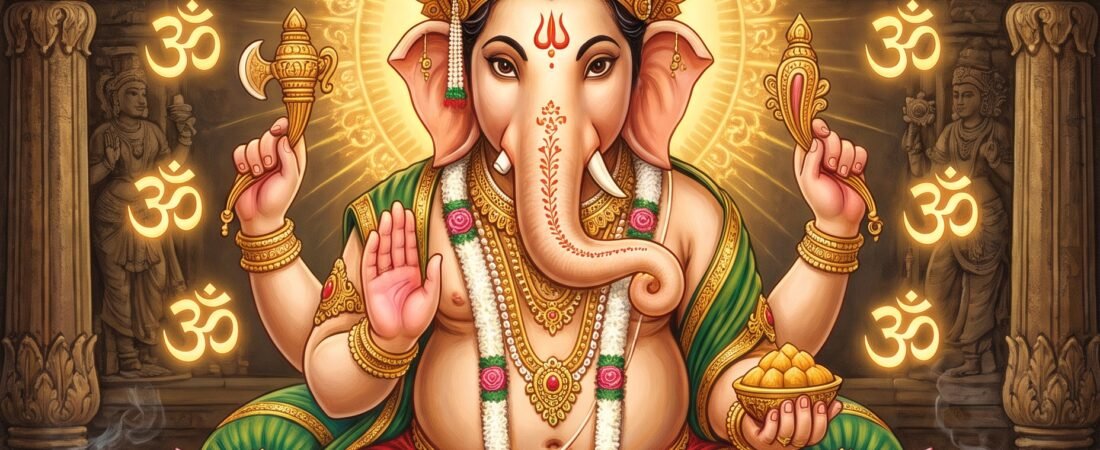
Quick Answer: Lord Ganesha, the elephant-headed deity, holds a central place in Vedic astrology as the remover of obstacles (Vighnaharta) and the lord of beginnings. In Jyotish, Ganesha is associated with the planet Mercury (Budh) — the planet of intelligence, communication and new ventures. Every auspicious muhurat, every new endeavour, and every astrological remedy begins with invoking Ganesha, because without his blessing even the most favourable planetary alignments cannot deliver their full fruit.
✨ 100% FREE
Discover Your Destiny with Astrova AI
Free Kundli • Daily Rashifal • AI Astrologer 24/7
⭐ Trusted by astrology enthusiasts across India
The Birth Story of Ganesha — Why He Has an Elephant Head
The most widely told origin of Lord Ganesha comes from the Shiva Purana. Goddess Parvati created a boy from the turmeric paste of her own body and set him to guard her chamber door. When Lord Shiva returned and was blocked by this unknown child, a fierce battle ensued. Shiva severed the boy’s head in his fury.
When Parvati’s grief shook the cosmos, Shiva promised to restore the child. He sent his ganas (attendants) northward with the instruction to bring back the head of the first creature they found sleeping with its head facing north — the sacred direction of spiritual awakening. They returned with the head of a young elephant (Airavata’s lineage in some versions), and Shiva placed it upon the boy’s body, breathing life back into him.
Shiva then declared: “This boy shall be known as Ganesha — Lord of the Ganas. He shall be worshipped before all other gods. No endeavour shall succeed without his blessing.”
This myth carries a profound astrological message: Ganesha represents the transformative power that turns loss into wisdom. The broken tusk he carries symbolizes sacrifice — he broke his own tusk to write the Mahabharata as Sage Vyasa dictated it, showing that true intelligence (Mercury) requires willingness to give something of yourself.
Ganesha and Mercury (Budh) — The Astrological Connection
In Vedic astrology, Ganesha is the presiding deity of Mercury (Budh), the planet that governs:
- Intelligence and analytical thinking — the ability to process information and make decisions
- Communication — speech, writing, negotiation and all forms of expression
- New beginnings — business launches, educational pursuits, travel
- Adaptability — the capacity to navigate change with wit and resourcefulness
When Mercury is strong in your Kundli (birth chart), you naturally embody Ganesha’s qualities: sharp intellect, eloquent speech, and the ability to find creative solutions. When Mercury is afflicted — retrograde, combust, or placed in a challenging house — Ganesha’s remedies become especially important.
| Mercury Placement | Effect | Ganesha Remedy |
|---|---|---|
| Mercury in 1st house | Strong intellect, natural leadership | Chant Ganesha mantra for clarity of thought |
| Mercury in 6th house | Analytical mind but prone to worry | Offer durva grass to Ganesha on Wednesdays |
| Mercury retrograde | Miscommunication, delays in contracts | Light a green candle before Ganesha and recite Budh mantra |
| Weak Mercury in D9 (Navamsa) | Difficulty expressing inner wisdom | Keep a Ganesha yantra in your study or workspace |
The Ganesha Mantra — “Om Gam Ganapataye Namaha”
The most powerful Ganesha mantra in Vedic tradition is:
“Om Gam Ganapataye Namaha”
Breaking down the syllables:
- Om — the primordial sound, representing the universe
- Gam — the seed (bija) mantra of Ganesha, carrying his specific vibrational frequency
- Ganapataye — “to the Lord of the Ganas” (Ganapati is another name for Ganesha)
- Namaha — “I bow” or “I surrender”
Astrologers recommend chanting this mantra 108 times (one mala) on Wednesdays — the day ruled by Mercury. The practice is believed to strengthen Mercury’s influence in your chart, clear communication obstacles, and remove the karmic blocks that delay success.
Ganesha in the Context of Muhurat — Why Every Auspicious Moment Begins with Him
If you have ever checked a Panchang (Hindu almanac) for an auspicious date, you would have noticed that every muhurat begins with a Ganesha invocation. This is not merely ritual — it is astrological necessity.
Ganesha rules the threshold between the known and the unknown. In astrological terms, he governs the Ascendant (Lagna) — the point of the zodiac rising on the eastern horizon at the moment of your birth. The Lagna represents your physical body, your identity, and the lens through which you experience life. A strong Lagna, blessed by Ganesha’s energy, gives you the vitality and clarity to pursue your dharma.
This is why:
- Weddings begin with Ganesha puja before the couple exchanges vows
- House-warming ceremonies (Griha Pravesh) invoke Ganesha first
- Business launches and vehicle purchases start with his blessing
- Students pray to Ganesha before exams
Even in the most favourable planetary transit, if Ganesha is not invoked, the energy lacks direction. He is the gatekeeper who ensures that the cosmic blessings flowing through other planets actually reach you.
The Story of Ganesha and the Cosmic Race — What It Teaches About Astrological Wisdom
One of the most beloved Ganesha stories from the Ganesha Purana illustrates why he is considered the wisest of all deities.
Lord Shiva and Parvati announced a competition: whoever circles the entire universe first would receive a divine fruit (the Jnana Phalam, fruit of knowledge). Kartikeya (Ganesha’s brother, the war god) immediately mounted his peacock and flew off to circle the cosmos.
Ganesha, whose vehicle is a small mouse, knew he could not win a physical race. Instead, he walked calmly around his parents — Shiva and Parvati — and declared: “My parents are my universe. By circling them, I have circled everything.”
Shiva and Parvati were deeply moved. Ganesha received the fruit.
The astrological lesson is profound: Mercury’s greatest gift is not speed but wisdom. While Mars (Kartikeya) charges forward with action, Mercury (Ganesha) pauses to understand. In your own life, when you face a decision, the Ganesha approach asks: What is the real goal here? Is there a simpler, wiser path?
This is the energy that Vedic astrology activates when Mercury is well-placed — the ability to see the whole picture without running yourself into the ground.
Ganesha Chaturthi — The Festival That Aligns You with Cosmic Beginnings
Ganesha Chaturthi falls on the fourth day (Chaturthi) of the waxing moon (Shukla Paksha) in the Hindu month of Bhadrapada (typically August–September). This festival is not just a celebration — it is an astrological reset.
The fourth tithi (lunar day) is ruled by Ganesha himself. On this day, the Moon’s emotional energy combines with Ganesha’s obstacle-removing power, creating a unique window for:
- Setting new intentions — anything started on Ganesha Chaturthi carries the energy of fresh beginnings
- Clearing old karmic blocks — the Chaturthi tithi is considered ideal for removing obstacles that have stalled your progress
- Strengthening Mercury — if your Kundli shows a weak Mercury, performing Ganesha puja on this day is one of the most powerful remedies
The festival lasts 10 days, ending on Anant Chaturdashi, when the Ganesha idol is immersed in water (Visarjan). This immersion symbolizes the cycle of creation and dissolution — Ganesha returns to the cosmic waters, and will return again next year, just as planetary cycles repeat.
Practical Ganesha Remedies for Common Astrological Challenges
Here are specific Ganesha-based remedies that Vedic astrologers recommend for common planetary challenges:
| Challenge | Planetary Cause | Ganesha Remedy |
|---|---|---|
| Constant delays in work | Afflicted Mercury or Saturn | Offer 21 modaks to Ganesha on 21 consecutive Wednesdays |
| Speech problems or stage fright | Weak Mercury in 3rd house | Recite “Om Gam Ganapataye Namaha” 108 times before speaking engagements |
| Financial instability | Weak 2nd house or afflicted Jupiter | Keep a Ganesha idol in your cash drawer or wallet |
| Exam anxiety | Mercury under stress from Rahu | Write “Gam” on your exam paper with a green pen before starting |
| Relationship misunderstandings | Mercury-Venus conflict in chart | Offer green moong dal to Ganesha every Wednesday |
✨ 100% FREE
Get Your Personalized Ganesha Remedy with Astrova AI
AI-powered Kundli analysis identifies your Mercury placement and suggests specific remedies
Frequently Asked Questions
1. Why is Ganesha worshipped before other gods in Hindu tradition?
Lord Shiva himself decreed that Ganesha must be worshipped first, before any other deity. This is because Ganesha removes obstacles (Vighna) that could otherwise block the success of any endeavour. In astrological terms, he clears the path so that the blessings of other planetary deities can reach you without obstruction.
2. Which day of the week is dedicated to Ganesha?
Wednesday (Budhvar) is dedicated to Ganesha, as it is ruled by Mercury (Budh). Fasting, chanting, or performing Ganesha puja on Wednesdays is considered especially powerful for strengthening Mercury in your Kundli.
3. What is the significance of Ganesha’s broken tusk in astrology?
Ganesha’s broken tusk represents sacrifice for the sake of knowledge. He broke it to write the Mahabharata, showing that true wisdom requires giving something of yourself. In astrological interpretation, the tusk symbolizes Mercury’s ability to concentrate one-pointed focus — the single tusk represents undivided attention.
4. Can Ganesha remedies help if Mercury is retrograde in my chart?
Yes. Mercury retrograde causes delays in communication, contracts and travel. Ganesha remedies — especially chanting “Om Gam Ganapataye Namaha” and offering durva grass on Wednesdays — are considered among the most effective ways to pacify a retrograde Mercury’s challenging effects.
5. What is the connection between Ganesha and the Muladhara chakra?
In Kundalini yoga, Ganesha is the presiding deity of the Muladhara (root) chakra at the base of the spine. This chakra governs survival, stability, and grounding. A balanced Muladhara — blessed by Ganesha’s energy — gives you the foundation to pursue higher goals without fear or insecurity.
Explore More Astrova Guides
- How to Generate Your Janam Kundli Online for Free
- How to Check Your Daily Rashifal Using Your Moon Sign
- How to Check Kundli Milan for Marriage Compatibility
- How to Check if You Have Sade Sati — Step-by-Step Guide
- AI Palm Reading — Complete Guide
- How to Use AI Astrology for Daily Life Guidance
About the Astrova AI Editorial Team
The Astrova AI Editorial Team combines the wisdom of classical Jyotish (Vedic astrology) with modern AI technology. Our content draws from authoritative sources including the Brihat Parashara Hora Shastra, Phaladeepika by Mantreswara, Uttara Kalamrita by Kalidasa, and the Jaimini Sutras. Every article is crafted to make ancient astrological wisdom accessible and practical for modern life.
Have a correction or question? We welcome feedback. Reach us at support@theastrova.com
Related posts:
 What Is the Bhrigu Samhita — The Ancient Palm Leaves That Predict Your Destiny?
 What Does Your Marriage Line on the Palm Reveal About Your Love Life and Relationship Timing?
 What Is Kemadruma Yoga In Your Kundli And Does It Really Cause Poverty?
 What Is Bhratrikaraka In Jaimini Astrology And What Does It Reveal About Your Siblings?